My Quilt History Study Group put together a Red and Green exhibit for our Quilts on the Grand quilt show last weekend. We auditioned quilts from members and friends, and picked the ones that we thought best illustrated the Classic Floral Applique style. It was a great success, with even the husbands examining the quilts close up. I heard one woman say "Oh, they have some OLD quilts." I thought it was a great opportunity to educate people a little about antique quilts.
This is a classic four block applique style quilt in the Coxcomb pattern. It has green sashing between the blocks, which is unusual for this style, and pink and yellow accent colors.

This is an example of what Ricky Clark, in her book Quilted Gardens: Floral Quilts of the Nineteenth Century, calls a Floral Star block structure. It has a center motif, and two others, one on the horizontal and vertical axes, in this case the coxcombs, and one on the diagonal axes, the princess feathers.

Notice the reverse applique in the center and in the middle of the feathers.

This quilt is an example of the Symmetrical Sprig style, in which the left and right halves of the motif are mirror images. It has the date, 1856, quilted into it.
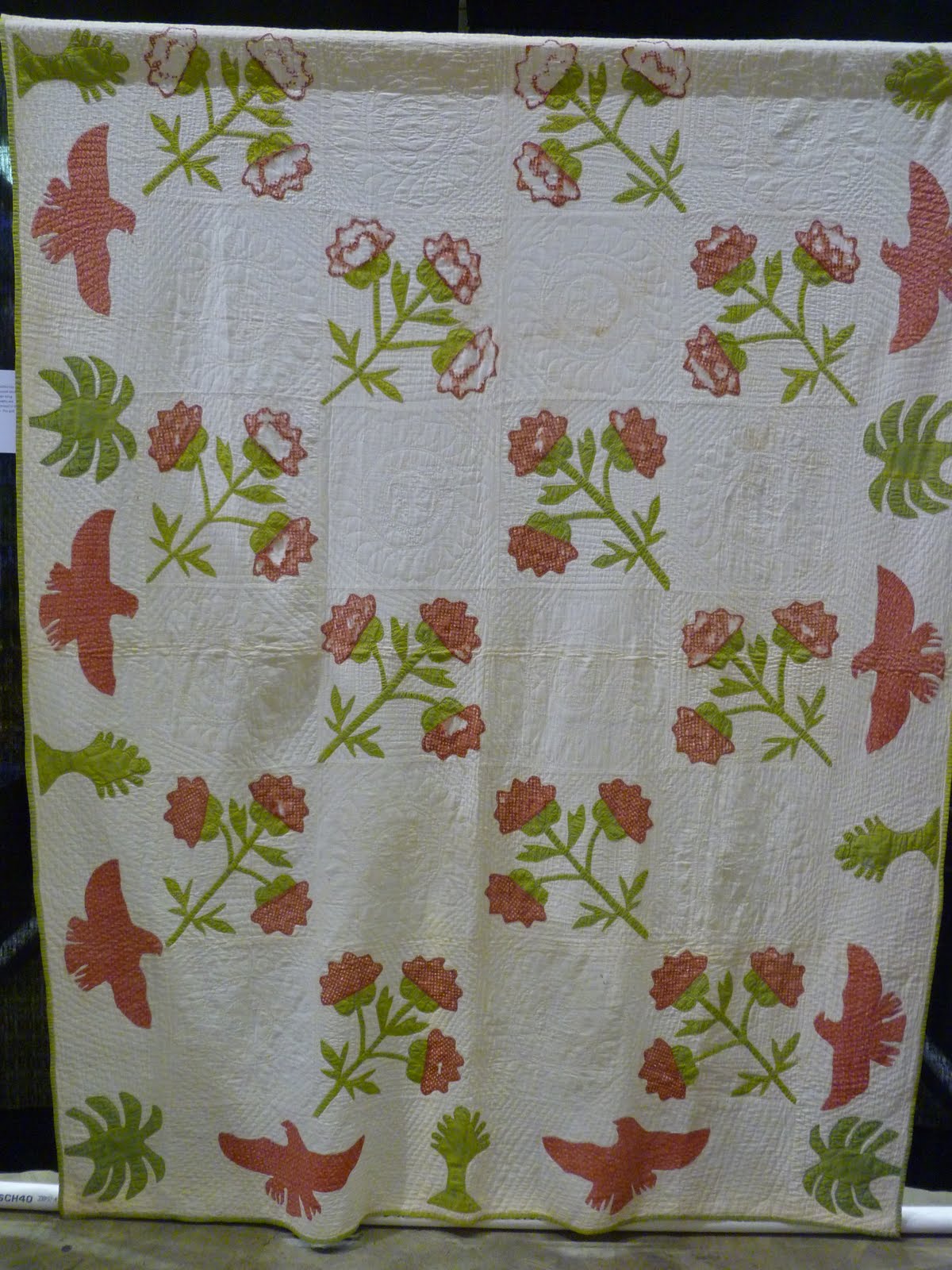
Instead of the more common undulating vine or swag border, this one has a border with eagles and tree like designs.

It's unusual to find a Classic Floral Applique quilt that is not made of repeating blocks, as in this undulating vine quilt, but it looks like it might actually be an asymmetrical floral sprig block, with the bottom stem extended down under the next rose.

This quilt also contains reverse applique.

This was my personal favorite, a less commonly seen Pineapple design. Pineapple patterns in quiltmaking are of either one large fruit set on the diagonal, or four mirror images radiating from the center.

I knew the pineapple was the universal symbol of hospitality, but didn't know it was because sea captains impaled them on their entry gates when they returned from the sea. I love the bud and feather border motif with the alternating red and yellow buds.


If you read my post on the Study Day, you recognize the alternating berry and leaf vine border adapted from woven coverlet border designs. Instead of one continuous piece, the vines are separate pieces on each side.

This is a Whig Rose, or Rose of Sharon pattern. It was made by members of the Rhinehart family in the mid-1850's, and was passed down through the family, used only as a "best" or company spread.

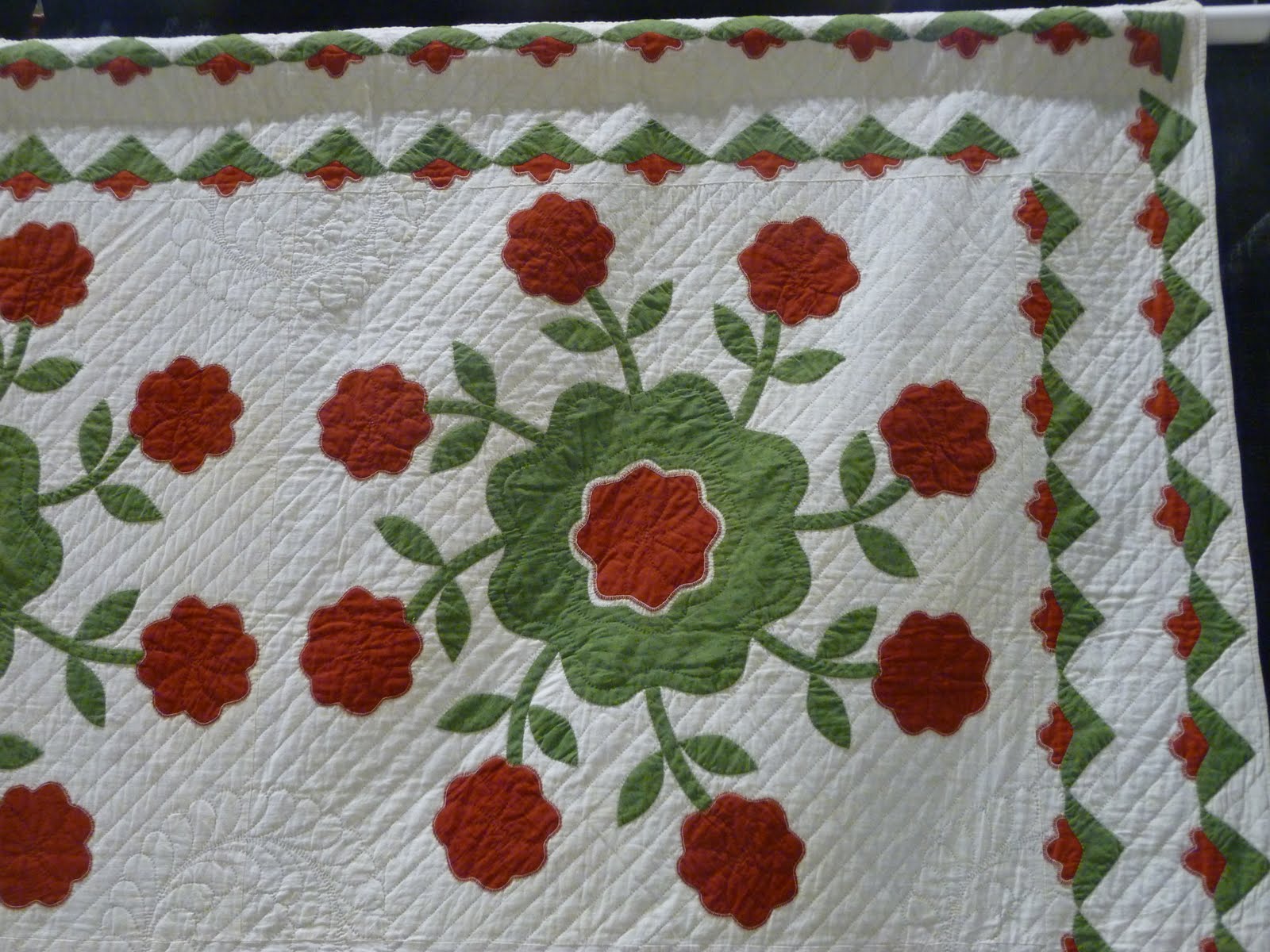
It has an unusual double border of buds.

The maker edged the applique pieces with a buttonhole stitch, but with the edge on the inside of the piece, instead of around the outside. I marvel at how even the line is without the edge to guide her!

This is another pieced and appliqued design, the Pieced Basket. It is also an example of a symmetrical flower and bud design, with the halves mirror images of each other. The border vine is cheddar on two sides, and green on the other two.

The vine border is similar to one found on a quilt in the "dower chest" of Jane Roan in Lancaster, PA in 1778.

A Turkey Tracks pattern, with an undulating vine and bud border.

This is my favorite Ely and Walker "poison" green fabric.

Another stunner, this is the Flower and Urn, or Flower Basket pattern.

This quilt features a central medallion, rather than the usual one block repeating pattern.

It is also unusual in that the floral arrangement is asymmetrical, meaning the right and left halves are not mirror images of each other.

I highly recommend both Quilted Gardens, and Jeana Kimball's Red and Green: An Applique Tradition books for further information on Red and Green Quilts.
More pictures of the show coming soon!
The winners of my giveaway are Gilli and Dorothy. Please contact me with your mailing addresses and I will send you your necklace and fabric. Thanks to all who left comments or emailed me.